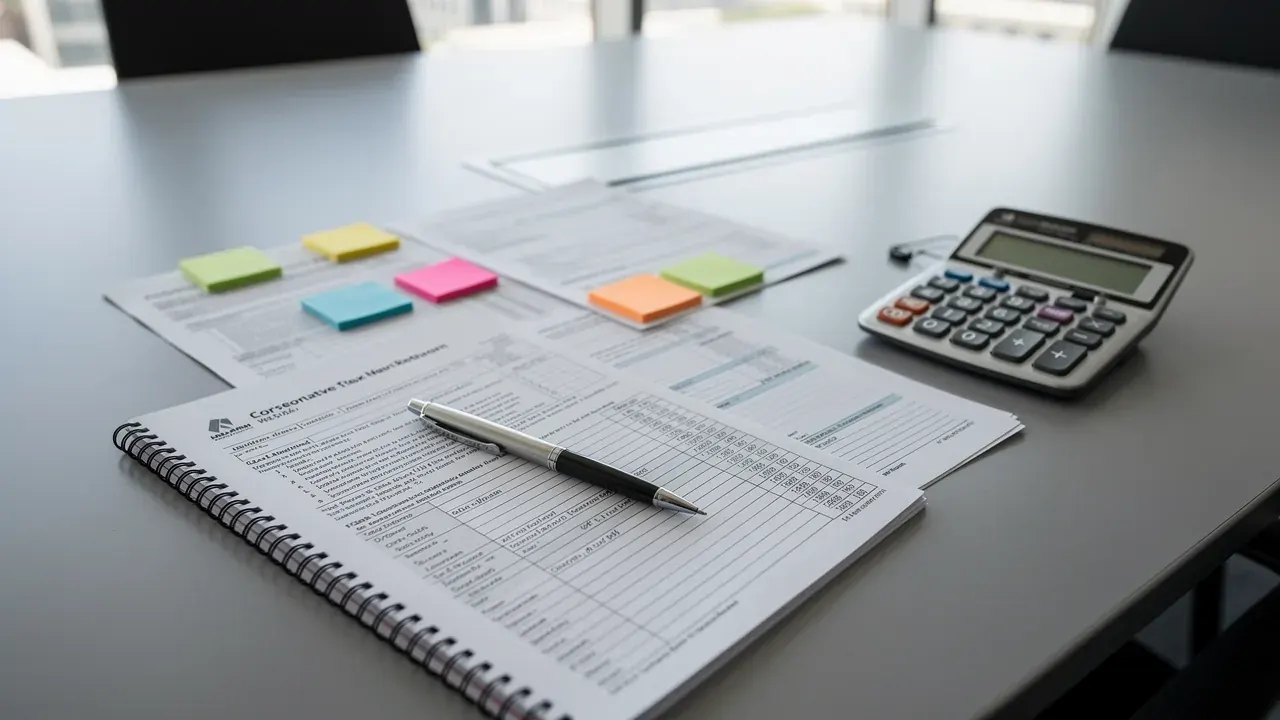
T2 returns and year-end statements for Ontario corporations
Corporate Tax Accountant in London, Ontario
A&P Accounting & Tax Experts prepares T2 corporate tax returns for incorporated businesses in London and Southwestern Ontario, including owner-managed operating companies, holding companies and medical and dental professional corporations. We take you from the year’s bookkeeping to finished financial statements, a filed T2 and the T4 or T5 slips that pay you.
Corporate tax is where small decisions compound. A shareholder loan left on the balance sheet, a business limit that was never shared between related companies or a dividend that should have been salary can each cost more than the accounting fee.
That is why every T2 we prepare ends with a draft review meeting. You see taxable income and the options before we file, not after the Notice of Assessment arrives.
- 5.0 stars on Google
- Downtown London office
- In person or fully online
- Open Saturdays
What we prepare
Corporate Tax Return (T2) Services for London Businesses
The T2 is the Corporation Income Tax Return, filed with the CRA by every resident corporation, every year, even if it had no income or was inactive. It carries the corporation’s financial statements in a standardized format called GIFI (General Index of Financial Information), plus the schedules that turn accounting profit into taxable income.
Ontario corporate income tax is calculated on Schedule 500 and filed on the same federal T2, so there is no separate provincial tax return. Nearly every corporation must now file the T2 electronically. The CRA explains the basics on its corporation income tax return page.
T2 Preparation and E-Filing
A typical small business T2 includes Schedule 1 (reconciling accounting income to taxable income), Schedule 8 (capital cost allowance), Schedule 50 (shareholder information), GIFI Schedules 100, 125 and 141, and Ontario Schedule 500. Corporations claiming the small business deduction add Schedule 7, and related companies add Schedules 9 and 23.
We e-file through CRA-certified software and send you the filing confirmation.
Year-End Financial Statements
Most T2s start with year-end statements prepared as a compilation engagement under CSRS 4200, the Canadian standard that replaced the Notice to Reader. You get a balance sheet, income statement and notes that your bank and the CRA can both use.
For statements, management reports and lender packages through the year, see our small business accounting and financial statements service.
T4, T5 and T5018 Slips
Salary paid to you or your staff is reported on T4 slips, and dividends on T5 slips, both due by the last day of February. Construction businesses that pay subcontractors file T5018 slips, due six months after the end of the reporting period.
We prepare the slips and summaries so they tie exactly to the payroll accounts and dividends declared in the minute book.
Holding Companies and Professional Corporations
Holding companies receive dividends from operating companies, hold investments or own real estate, and are usually associated with the operating company for tax purposes. Associated corporations share one small business limit and must report their relationships on every return.
Ontario physicians and dentists can incorporate as professional corporations and, unlike most other professions, can have family members hold non-voting shares, subject to the tax on split income rules.
Key dates
T2 Filing Deadlines and Balance-Due Dates
A T2 is due six months after your fiscal year-end, but the tax is due much sooner: two or three months after year-end. That gap catches many first-time corporate owners, who file on time and still pay months of interest.
| Obligation | Due date | December 31, 2026 year-end |
|---|---|---|
| T2 return | Six months after year-end | June 30, 2027 |
| Balance owing (most corporations) | Two months after year-end | February 28, 2027 |
| Balance owing (CCPCs claiming the small business deduction with prior-year taxable income of $500,000 or less, as a group) | Three months after year-end | March 31, 2027 |
| Instalments | Monthly, or quarterly for eligible small CCPCs, once tax payable exceeds $3,000 | Through the 2027 fiscal year |
| T4 and T5 slips | Last day of February | February 28, 2027 |
| Late-filing penalty | 5% of unpaid tax plus 1% a month, up to 12 months | Starts July 1, 2027 if tax is owing |
The CRA sets out the rules on when to file your T2 and on corporate payments and instalments.
Owner pay
Salary or Dividends: Paying Yourself From Your Corporation
There is no single right answer, but there is a right answer for your year. Salary builds RRSP room and CPP while adding payroll paperwork; dividends are simpler but leave you without either.
Most owner-managers end up with a mix, and the right mix shifts as income, family and retirement plans change. Ontario’s 2026 budget also reduces the dividend tax credit on non-eligible dividends from 2027, which is a good reason to rerun the comparison this year.
| Factor | Salary | Dividends |
|---|---|---|
| RRSP room | Creates room at 18% of earned income, up to the annual limit | Creates no RRSP room |
| CPP | Corporation and owner both contribute, building your CPP pension | No CPP contributions and no CPP pension credit |
| Payroll obligations | Payroll account, source deduction remittances and a T4 slip | Director’s resolution and a T5 slip |
| Corporate tax | Deductible to the corporation | Paid from after-tax profit |
| Personal tax | Taxed as employment income | Taxed at lower rates through the dividend tax credit |
| Proof of income | A T4 is simple for mortgage lenders | Lenders often want two years of T5s and statements |
Paying dividends to a spouse or adult children brings in TOSI, the tax on split income, which taxes those dividends at the top rate unless an exclusion applies, such as a family member who works in the business at least 20 hours a week. Our owner-manager tax planning models salary, dividends and family pay together.
Not sure if you should take salary or dividends this year?
Call before your year-end and we will model both on your actual numbers.
How it works
Our Corporate Tax Preparation Process
A T2 is only as good as the books it is built on, so our process starts well before the tax software opens. Here is the sequence we follow for every corporate year-end.
Year-End Checklist and Bookkeeping Review
We send a checklist, then review your QuickBooks Online or Xero file: bank and credit card reconciliations, the shareholder loan account, accruals, and HST and payroll balances that should match CRA records.
Adjusting Entries and Financial Statements
We record amortization on equipment and vehicles, prepaid expenses, inventory counts and year-end accruals, then compile the balance sheet, income statement and notes.
T2 Draft Review Meeting
We walk you through taxable income, the tax owing and the choices still open, such as bonus accruals, dividend amounts and how much CCA to claim, before anything is filed.
Filing, Slips and Next-Year Planning
We e-file the T2, issue T4 or T5 slips, confirm the balance-due date and set next year’s instalments so there are no surprises.
What goes wrong
Common T2 Mistakes That Lead to CRA Reviews
Most CRA reviews of small corporations do not start with fraud. They start with predictable errors that an experienced preparer spots in the first hour with the general ledger.
Shareholder Loan Balances Left Too Long
When you take more out of the company than you have put in or been paid, the shareholder loan account goes into a debit balance. Under subsection 15(2) of the Income Tax Act, a loan not repaid by the end of the corporation’s next fiscal year is added to your personal income.
Repaying it with a new loan right after year-end does not work; the CRA looks at the series of loans and repayments.
Personal Expenses Run Through the Company
A family vehicle, home renovations or personal travel paid by the corporation are either non-deductible or a taxable benefit to you, and the HST input tax credits claimed on them are disallowed too.
We reclassify these to the shareholder account or a T4 benefit before the CRA does it with penalties.
Missing or Shared Small Business Deduction
Associated corporations must share the $500,000 business limit through Schedule 23, and a holding company with significant investments can reduce it further. Once the group’s passive investment income exceeds $50,000, the limit shrinks, and it disappears at $150,000.
Claiming the full limit on two related companies is a common reassessment trigger.
Late or Missing T4 and T5 Slips
Information slips have their own penalties, separate from the T2. For small filers the CRA applies a reduced penalty, starting at a flat $100 for one to five late slips and rising with the number of slips, up to $1,000 for 11 to 50.
Dividends declared in the minute book but never slipped are a frequent finding when we take over a file.
Worried about something on last year’s T2?
Call us for a second look. We can review a prior return and tell you what, if anything, needs fixing.
Fees
Corporate Tax Return Pricing

In the London market, a T2 with compiled year-end financial statements typically starts at around $1,500. Where your corporation falls above that depends on how much work sits between your books and a finished return.
- Revenue and complexity. Inventory, work in progress and multiple revenue streams take longer to close.
- Transaction volume. More bank and card activity means more to review and reconcile.
- Number of entities. An operating company plus a holding company means two T2s and coordinated planning.
- Condition of the books. Reconciled monthly books cost far less to close than a year of unreconciled entries.
- Slips and extras. T4, T5 and T5018 slips, GST/HST returns and catch-up years.
We review your file and quote a fixed fee before work starts. Our fees for London accounting and tax work explain how we price each service.
Why us
Why London Business Owners Choose A&P for Corporate Tax
Business owners want a corporate accountant who notices problems early and explains them plainly. That is the standard we hold every year-end to.
Books to T2 in One Place
Bookkeeping review, financial statements, the T2, slips and your personal return handled by one team that sees how they connect.
A Draft Review Before Filing
No T2 is filed until you have seen taxable income and the planning options it leaves open.
Five Stars From Every Reviewer
A 5.0 rating from 11 Google reviews, with attention to detail mentioned again and again.
Corporate Tax FAQs
Do I need a CPA to file a corporate tax return in Canada?
No. The CRA does not require a CPA, or any designation, to prepare and file a T2 corporate tax return, and many owners file through an accounting and tax firm that is not a CPA practice. The CPA title itself is regulated, and in Ontario only holders of a Public Accounting Licence can perform audit and review engagements.
When choosing a preparer, what matters is experience with corporations like yours, a clear process for the year-end close and someone who will answer the CRA for you if questions come up later.
What happens if I miss my T2 deadline?
If the corporation owes tax, the late-filing penalty is 5% of the unpaid balance plus 1% for each full month late, up to 12 months. If the CRA has already sent a demand to file and the corporation was penalized in any of the three previous years, the penalty rises to 10% plus 2% a month for up to 20 months. Interest on unpaid tax runs from the balance-due date either way.
Late returns also delay refunds and can hold up related filings like a GST/HST rebate or a bank renewal that needs filed statements.
Does my corporation have to file if it had no income?
Yes. Every resident corporation must file a T2 every year, even if it was inactive, earned nothing or owes no tax. An inactive corporation still files a nil return with its balance sheet information.
Leaving a dormant company unfiled can lead to CRA demands and penalties, and the corporation may eventually be dissolved by the province for not keeping up its Ontario filings.
What is the small business tax rate in Ontario?
For active business income up to $500,000 earned by a Canadian-controlled private corporation, the combined federal and Ontario rate was 12.2% until June 30, 2026 and is 11.2% from July 1, 2026. The federal rate is 9%, and Ontario cut its small business rate from 3.2% to 2.2% on July 1, 2026, so a year that straddles that date is prorated by days.
Income above the $500,000 business limit is taxed at the general combined rate of 26.5%, and the limit shrinks once passive investment income in the corporate group passes $50,000.
Can you take over from my current accountant mid-year?
Yes, and mid-year is often the easiest time. We need last year’s T2 and financial statements, the closing trial balance or general ledger, and authorization through the CRA Represent a Client service so we can see your corporate accounts in My Business Account.
We also ask your previous accountant for carryforward balances that drive future returns, such as undepreciated capital cost, the capital dividend account, GRIP and any non-capital losses, so nothing gets lost in the hand-off.
Keep exploring
Related Services and Areas We Serve
A corporation needs more than a T2 to run smoothly. These are the services our corporate clients pair with their year-end, and the communities around London where many of them are based.
Small Business Accounting
Financial statements, management reports and cash flow help through the year.
Corporate Bookkeeping
Monthly reconciled books that make the year-end close fast and inexpensive.
Payroll for Owner-Managers
Salary, source deductions, remittances and the T4 slips that come with them.
Corporate Tax Planning
Salary versus dividends, holding companies and year-end timing decisions.
Corporate Tax Help for Woodstock Businesses
Oxford County manufacturers, suppliers and farm corporations along Highway 401.
T2 Returns for St. Thomas Corporations
Incorporated trades and Elgin County businesses filing with us in person or online.
Dorchester and Thames Centre Corporations
Owner-managed companies just east of London, a short drive from our office.
Get a Quote for Your Corporate Year-End
Tell us your year-end date, what software your books are in and whether there is a holding company involved. We will tell you what the T2 package includes and what it will cost.